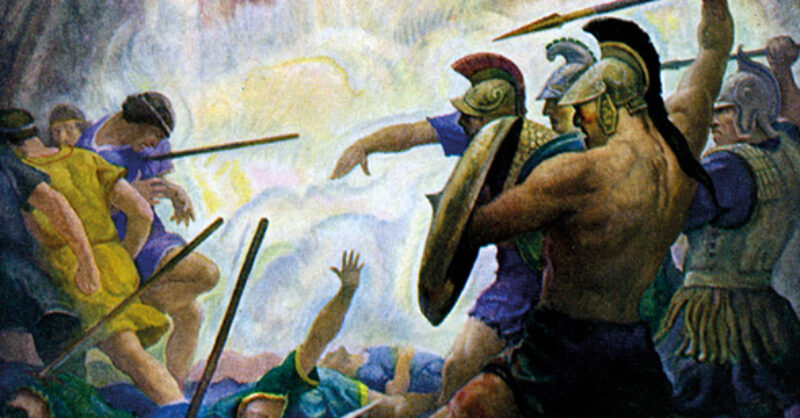
When Odysseus finally returns to Ithaca after the Trojan War, he finds the suitors feasting in his palace. Disguised as a beggar, he strings his great bow and turns his furious vengeance on them. The suitor Antinous takes the first arrow through the throat as he lifts his cup. Over one of the text’s 24 books, Homer describes how more than 100 suitors are mown down among the wreckage of tables. The housemaids who shared the suitors’ beds are hanged in a line, their pale legs twitching in their death throes. The goat-herd Melanthius is mutilated at the storeroom door. Homer tells the tale without apology, indeed with a sense of relish. While the modern reader is likely to find the extent of Odysseus’s revenge excessive, the poem’s own world betrays no such unease.
Retaliation, retributive justice and punishment are juridical and criminological concepts. Revenge is not. It is a notion many in liberal modern societies may consider distasteful. The state is the arbiter of legitimate force. But while society has turned vengeful retribution into condign punishment, the impulse for vengeance has not disappeared. We tell those who feel wronged that anger poisons only the one who holds it, that forgiveness is maturity.
“Homer's Odyssey depicts brutal revenge, while Lupita Nyong'o and Samuel Butler clash over its female perspective.”
Into this debate steps the latest Hollywood blockbuster version of The Odyssey. Promoting the film, Lupita Nyong’o, who holds a bachelor’s degree in film and theatre studies from Hampshire College, Massachusetts, declaimed to an interviewer: “When you read the Iliad and the Odyssey, very little time is spent in the perspective of the women. It’s told from a very masculine side of things.”
Yet the Victorian writer Samuel Butler was so struck by the highly feminine character of the Odyssey that he wrote an entire book on the subject. Butler, a wonderfully intelligent and puckish mind indifferent to conventional proprieties — homosexual, author of the hilarious The Way of All Flesh — argued in his 1896 book The Authoress of the Odyssey that the poem was strongly suggestive of being written by a woman. He mounted evidence that whoever wrote the Odyssey had very little idea about the construction of boats, putting rudders at both ends, about how sheep feed their young, about the sound of wind at sea, about hawks tearing prey apart, and evidently believed that “dry and well-seasoned timber can be cut from a growing tree”.
Butler’s proposition, published 130 years ago, offers a lens through which to read the epic — one that challenges the assumption that the Odyssey is simply a masculine tale of vengeance. As modern audiences grapple with the poem’s visceral violence, the question of who wrote it may be just as unsettling.