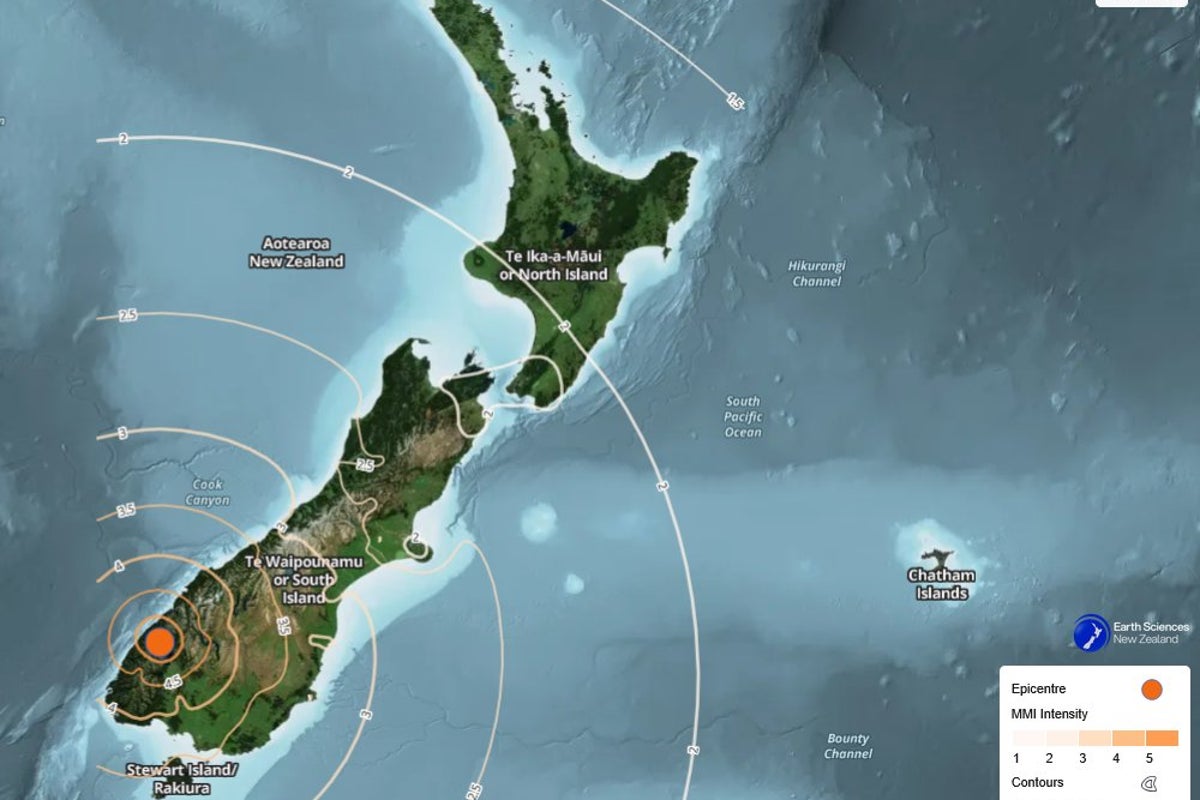
At 9.14pm local time on a Wednesday evening, a magnitude-5.9 earthquake struck 40km north of Te Anau on New Zealand's South Island, shaking buildings, sending residents rushing outdoors, and briefly triggering a tsunami warning that forced people to evacuate to higher ground. This event, which centred near the tourist hotspot of Fiordland National Park, is a reminder that New Zealand is one of the most seismically active places on Earth, and its tsunami warning system is a vital part of life there.
When a large earthquake hits near the coast in New Zealand, the National Emergency Management Agency (NEMA) quickly assesses the risk of a tsunami. In this case, the earthquake was initially recorded at magnitude 6.3 by NEMA, then revised down to 5.9, according to GeoNet, the country's official geological hazard monitoring agency. The United States Geological Survey (USGS) also recorded it as 5.9. Because the quake was strong and shallow – at a depth of about 76km (USGS) or 53-94km (varying reports) – and happened close to the southwest coast of the South Island, NEMA issued a tsunami warning for a roughly 1,340-mile stretch of coastline from Milford Sound to Puysegur Point. The warning said "land inundation is likely" and ordered people to "move immediately to the nearest high ground, out of tsunami evacuation zones, or as far inland as possible."
“Explains why New Zealand has frequent earthquakes and how its tsunami warning system works, using the recent 5.9-magnitude quake near Fiordland as a case study.”
The reason such warnings are common is tectonic. New Zealand sits on the boundary of the Pacific and Australian tectonic plates. The plates are constantly colliding and sliding past each other, generating frequent earthquakes – over 20,000 people reported feeling this one, GeoNet noted. Earthquakes under the ocean floor can displace vast amounts of water, creating tsunami waves that travel at hundreds of miles per hour. The system is designed to be reactive: if an earthquake is large enough and close enough to the coast, authorities don't wait for a wave to be confirmed; they warn immediately. NEMA's message said: "The first wave may not be the largest. Tsunami activity will continue for several hours and the threat is real until this warning is cancelled." The warning was later downgraded, but coastal areas were still told to expect "strong and unusual currents and unpredictable surges at the shore".
Why should UK readers care? Although Britain is not in a high-risk earthquake zone, the country's geology is not immune to tsunamis – the 1755 Lisbon earthquake triggered waves that reached Cornwall. More importantly, many British tourists visit New Zealand every year, especially popular spots like Fiordland, Queenstown, and Milford Sound. If you are in a coastal area overseas and feel a long or strong earthquake that makes it hard to stand, or lasts longer than a minute, the advice from NEMA is clear: do not stay at home – move immediately to high ground or inland, and do not return until an official all-clear is given. The same principle applies in other tsunami-prone regions.
Six key questions for anyone travelling to New Zealand:
Q: How do I know if a tsunami warning has been issued? Local authorities use mobile alerts, sirens, radio, and social media. NEMA and New Zealand Civil Defence issue official warnings, often with threat maps showing which areas must evacuate.
Q: What should I do if I feel a large earthquake near the coast? If the shaking is strong enough to make standing difficult, or lasts more than a minute, move immediately to high ground or inland on foot, if possible, to avoid traffic jams. Do not wait for an official warning.
Q: Are tsunami waves always big and damaging? Not always, but they can be. The threat often comes from multiple waves, with the first not necessarily the largest. Unusual currents and surges can persist for hours, so stay away from beaches and waterways.
Q: Can a tsunami hit the UK? The risk is very low, but not zero. Historical examples like the 1755 Lisbon tsunami show that distant earthquakes can cause waves on UK shores, though they are usually small.
Q: How accurate are New Zealand's earthquake and tsunami warnings? Agencies like GeoNet and USGS rapidly revise magnitudes as more data comes in, which can cause changes to warnings. In this case, the initial magnitude estimate dropped, and the warning was lifted, but authorities stress it's better to err on the side of caution.
Q: What if I'm not near the coast but the warning says my area is at risk? Even if you don't feel the quake, you must evacuate if ordered. The warning said: "The earthquake may not have been felt in some of these areas, but evacuation should be immediate as a damaging tsunami is possible."
What happens next is unpredictable. New Zealand will continue to experience earthquakes because of its position on the plate boundary. Each event tests the warning system, and lessons from events like this one – where the magnitude was revised down but the threat was taken seriously – help improve future responses. For now, no damage or injuries were reported from this quake, but the message is clear: when the ground shakes, the clock starts ticking.