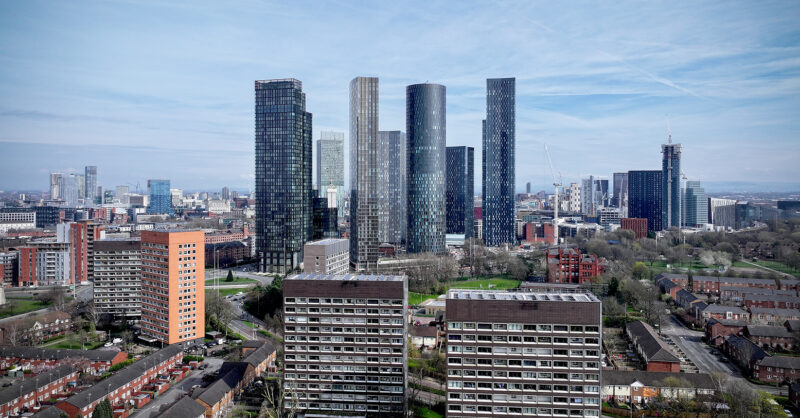
In his campaign launch video, Andy Burnham stands in Manchester’s St Peter’s Square, the yellow trams and gleaming Renaker skyscrapers behind him. “Manchesterism is the end of neoliberalism,” he declares, a phrase he has used to frame his apparently radical programme as a repudiation of four decades of economic policy since Margaret Thatcher. But critics argue that the “actually existing Manchester model” tells a different story.
The New Statesman this week argues that Burnham’s city is not a socialist beacon but a “neoliberal metropolis”. While his signature policy — bus re-regulation — has undoubtedly improved fares and coordination, the buses are not publicly owned, merely regulated by a more empowered authority. And the broader Manchester model, the magazine contends, has been to use the state to “de-risk profitability for a particular kind of rentier capitalism”, leveraging planning powers, public land and subsidies to create a real-estate-led regeneration that has driven displacement in the inner city.
“Andy Burnham's 'Manchesterism' is criticised as neoliberal despite his claims to have ended that era.”
Supporters like Mathew Lawrence have described “Manchesterism” as a “modern and functional response” to the high-inequality, low-growth trap of the 1980s, and as the “most advanced practical demonstration” of a “Productive State” that invests public assets for public provision. Yet the gap between the rhetoric and the reality, the New Statesman suggests, is wide.
Meanwhile, a separate examination of Burnham’s personal image has focused on his religious faith. The UnHerd website notes that before the year is out, Britain might have only its second-ever Catholic prime minister — and that no one seems bothered. Burnham was an altar boy, and his “cultural Catholicism” adds to a carefully constructed image. The article compares him to Tony Blair, a “crypto-Catholic” who converted only after leaving office, and Boris Johnson, a Catholic-born Prime Minister who reverted. Burnham, if elected, would be the first openly Catholic prime minister since the Reformation, a conquest of England that the author says has been achieved without the resistance that once greeted it.
But the question remains: can a politician who presides over a city built on neoliberal property speculation, while cultivating a Catholic image rooted in tradition, truly claim to have ended neoliberalism? For his critics, the buses may be regulated, but the city’s soul remains that of a rentier economy.