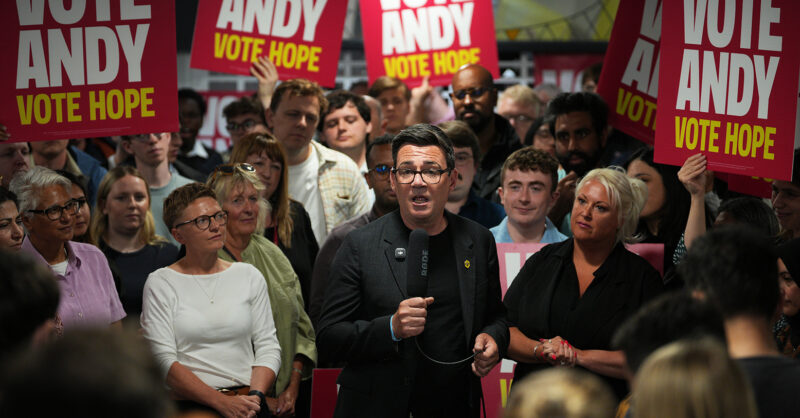
Andy Burnham chose a good day to win the Makerfield by-election. As far as the bond market is concerned, the timing was impeccable: Wednesday’s inflation figure came in lower than expected, and the Bank of England released a lower inflation forecast while keeping interest rates on hold. The market, as our political editor Ailbhe Rea revealed earlier this week, was more interested in the Strait of Hormuz than Makerfield. Burnham’s team had feared a surge in borrowing costs when markets opened at 8am, but concluded a win was priced in. Gilt yields shrugged upwards only slightly, mirroring European debt. The result made no significant change to investors’ expectations.
But the fragile peace with the bond markets may not last. Market participants say they are trading on the assumption that Ed Miliband – who has been advising Burnham on projecting fiscal discipline – will become chancellor. Burnham has also brought in Andy Haldane, former chief economist to the Bank of England, Jim O’Neill (previously chief economist at Goldman Sachs and a Treasury minister under George Osborne) and Richard Hughes, former chair of the OBR, as economic advisors. These appointments appear aimed at establishing market credibility. Yet Neil Mehta, macro portfolio manager at RBC Bluebay Asset Management, described the approach as “traditional, and almost Starmer-ish – I still expect Burnham here to come in and be a bit more revolutionary. Otherwise, what’s the whole point of his campaign?”
“Andy Burnham faces pressure to reverse Brexit as new study says EU membership could deliver £92bn growth.”
The market has taken at face value Burnham’s commitments to fiscal rules and manifesto promises. But those promises to voters differ sharply from what he has told investors. To effect political change, he would need to alter how the UK borrows – such as extending the forecast period for borrowing or separating defence spending from fiscal rules – changes the market would view unkindly because they signal more borrowing. Investors also say Burnham’s political abilities matter. Mehta said he is keeping a close eye on Burnham’s favourability rating because a key risk is that Burnham and Miliband prove no more popular than Starmer and Reeves, forcing them to make more concessions “to get the public on side, to bring back some of the voters from the right.”
Meanwhile, a fresh independent study published on Monday – commissioned by campaign group Best for Britain and carried out by Frontier Economics, a consultancy chaired by Dame Sharon White – argues that the only way to generate growth on the scale needed to deliver voters’ demands is to rejoin the European Union. The report, backed by Paul Johnson, former director of the Institute for Fiscal Studies, models the key benefits of EU membership and finds the prize dwarfs every other option. It suggests rebuilding ties with Brussels could deliver an economic windfall worth at least £92bn, equivalent to a growth boost of a minimum of 3.6 per cent over the next five to 10 years.
Naomi Smith, Best for Britain’s chief executive, said: “When it comes to generating growth on the vast scale required for politicians to deliver on the changes the public are crying out for, the economic heft of rejoining the EU is in a league all of its own, with no other policy lever even coming close.”
The report also argues that Britain would recover up to 90 per cent of Brexit’s economic hit to UK GDP. But any attempt to reverse Brexit would be politically toxic, risking a backlash from Nigel Farage’s Reform UK party and Kemi Badenoch’s Conservatives. Although polling shows support for closer ties with the EU among British voters since Brexit, the appetite for rejoining is less clear cut, split along generational lines.
Burnham, who claimed victory in Thursday’s by-election, has spent the weekend drawing up plans for power. With promises ranging from raising the income tax personal allowance threshold to a major hike in defence spending, he must find the money to pay for it. The bond markets may be calm for now, but the real test lies in reconciling what he has told voters with what investors expect – and whether a move towards Brussels becomes the price of growth.