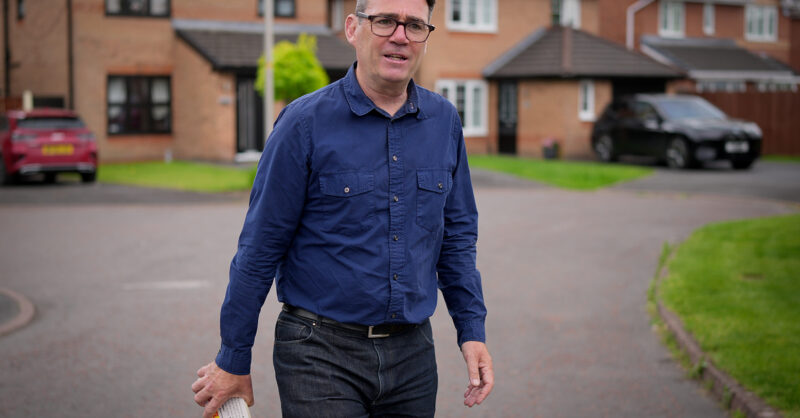
After nine years away, Andy Burnham walked back into the House of Commons on Monday as the newly elected MP for Makerfield — a landslide victory with a majority of more than 9,000 votes. The former Manchester mayor now has a clearer path to No 10 than ever before, yet questions over his core beliefs have grown louder.
Burnham’s public positions have shifted markedly on key issues. On immigration, he appeared to criticise Shabana Mahmood’s reforms — which include ending permanent refugee status and removing support from some asylum seekers — telling Radio 4 on 20 November: “I do have a concern about leaving people without the ability to settle… That might limit the Home Office’s ability to deal with the backlog. And it may leave people in a sense of limbo and unable to integrate.” Yet during the campaign, on 9 June, he struck a tougher tone: “It’s this thing about control, isn’t it? It feels like the country isn’t functioning properly… the small boats issue completely speaks to that. People want it to be dealt with. We do need to go further.” In the same interview he added: “We need to make greater use of detention so that people who have got no basis for a claim are not actually admitted to the country.”
“Andy Burnham returns to parliament after landslide win, but his shifting stances raise questions about his plans for No 10.”
Meanwhile, Burnham has been outspoken on fiscal policy. In an interview with the New Statesman published on 24 September, he declared: “We’ve got to get beyond this thing of being in hock to the bond markets.” He doubled down in a speech to the Institute for Fiscal Studies on 20 January, calling Britain’s condition a “low growth doom loop” and arguing that “our shallow, adversarial political system has shown itself incapable of lifting us out of it and it only adds to the volatility, so we do find ourselves stuck in a rut and in hock to the bond markets.” Yet just two days after the Makerfield by-election was announced, on 18 May, he insisted he would stick to the government’s current fiscal rules: “Let me say this really clearly. I support the fiscal rules. There needs to be a plan to get debt down,” he said, “but beyond that we need to change politics and take the turbulence out of British politics because that is a cause of uncertainty that then has that impact in the markets.”
These apparent contradictions have fuelled calls for a proper leadership contest rather than a coronation. Anand Menon, director of UK in a Changing Europe, warned: “A coronation would be a disaster for Britain.” He argued that the failure of the Starmer project showed “you need a clear plan if you are going to be effective” and that “coming to power then winging it is not a recipe for effective government.” Menon pointed to unanswered questions: “How, if at all, does he intend to get defence spending to 3.5 per cent of GDP? What, for that matter, does he think about any aspect of foreign affairs? Does he have a plan to control welfare spending?”
Burnham has committed to keeping the triple lock on the state pension and, after initially appearing to back state compensation for the Waspi women, his stance remains unclear. As he inherits a Labour Party split over immigration and faces the challenge of governing without a clear mandate from his own party, the question lingers: what does Andy Burnham really think?