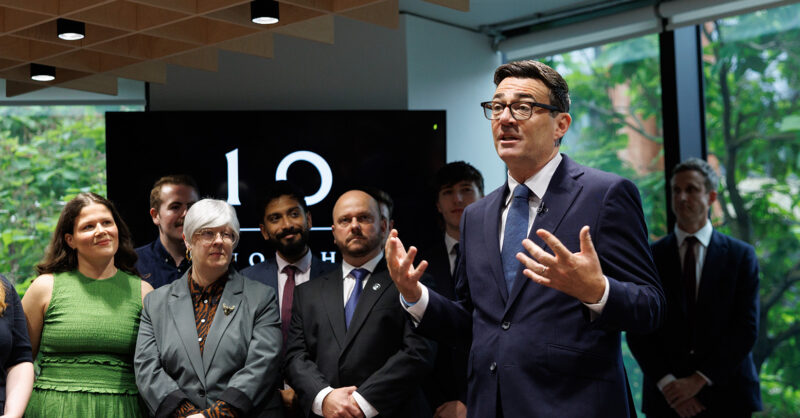
In his first major interview as prime minister, Andy Burnham told the BBC he would be prepared to call out Donald Trump to defend Britain’s “national interest before anything else.” The comment, made during a conversation with Laura Kuenssberg, signals a clear break from the deference often expected of a new UK leader facing a volatile US president.
Burnham, who took office in July 2026 after Labour’s general election victory, has little foreign policy experience. But he has wasted no time establishing a position on the UK-US relationship. Speaking on BBC One’s Sunday with Laura Kuenssberg, he said he had a good first conversation with Trump, describing him as “really warm.” However, asked twice whether he would trust the US president, Burnham declined to say yes, replying: “it’s a changing world, isn’t it, and you just obviously have to call things as they develop.”
“New PM Andy Burnham says he will publicly disagree with Trump to defend UK interests, as his social media-savvy image reshapes foreign policy.”
The sticking point is Iran. The Trump administration has resumed offensive operations against Iran, a policy the previous UK government (under Keir Starmer) did not support. Burnham has stuck to that line. His defence secretary, Wes Streeting, told Sky News he had been “clear that we have not supported offensive action in Iran and we won’t support offensive action in Iran.” Streeting added that Trump’s team does not want allies who “suck up” — rather, they value straight talk. Burnham himself said: “I can’t at any point say that I won’t take a different opinion from him [Trump], that I will need to voice a different idea that is right for Britain.” He ruled out an early general election, saying “people don’t want it.”
Burnham’s willingness to publicly disagree is a calculated strategy, experts note. He has cultivated a reputation as a “man of the people” — the former mayor of Greater Manchester who runs 10K races in a respectable 53 minutes and 15 seconds (the average for a British male), uses social media to project authenticity, and has been described as the UK’s “first truly social media savvy prime minister.” This approach, sometimes called “aura farming,” relies on internet vibes and personal relatability as much as policy. It may give him the domestic political capital to take a tougher line with Washington.
For UK readers, the stakes are high. The US is Britain’s most important ally, and defence ties are deep. Burnham has not committed to a date for meeting NATO’s target of spending 3% of GDP on defence — a goal his own chancellor, John Healey, resigned from the previous government over. Burnham said the “first challenge” is ensuring the defence investment plan is fully funded, and that they “need to work that through as we go towards the budget later this year.” If the government fails to increase spending, it risks looking weak on security. If it caves to Trump on Iran, it risks looking like a puppet.
Q: Will Andy Burnham stand up to Donald Trump? Burnham has said he will “of course” call out Trump if it is the right thing for Britain. He has already maintained the previous government’s opposition to US offensive operations in Iran. However, he also described his first call with Trump as “warm” and has not ruled out future cooperation.
Q: What is “aura farming” and does Burnham do it? “Aura farming” is the practice of using social media and public appearances to cultivate a cool, relatable image — often prioritising “vibes” over policy. Channel 4 News has described Burnham as the UK’s “first truly social media savvy prime minister,” pointing to his regular running, charity events, and down-to-earth manner as examples.
Q: What is Burnham’s defence spending plan? Burnham has not set a date to reach 3% of GDP on defence, despite his chancellor John Healey previously arguing it must be done by 2030. The PM said the first priority is ensuring the current defence investment plan is “fully funded” and that details will be worked out before the autumn budget.
What happens next depends on the budget, expected later this year, where Burnham must show how he will fund defence commitments. Meanwhile, his relationship with Trump will be tested as US operations in Iran continue. If Burnham sticks to his word and voices disagreements publicly, it could redefine the UK-US “special relationship” for a new era — or spark a diplomatic crisis that his social media charm may not be able to smooth over.