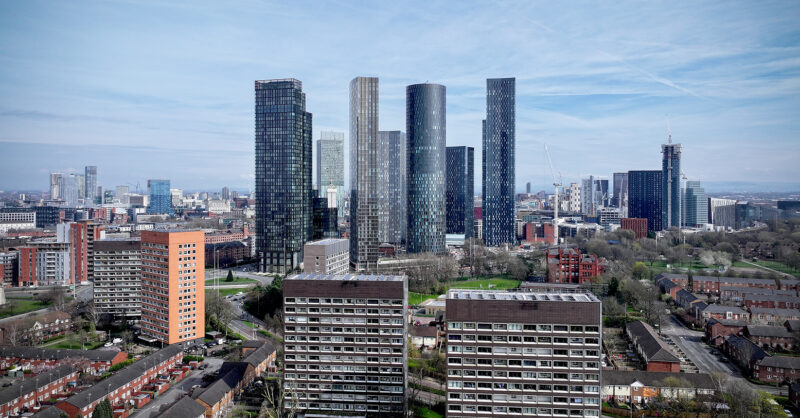
“I knew in my heart politics in this country had to change. And that’s what I came back here to do. And that…” Andy Burnham pauses, gesturing across St Peters’ Square, past the yellow trams and the glass of Renaker’s skyscrapers. “… is exactly what we have done. Working side-by-side with business we’ve built the country’s fastest growing economy. Manchesterism is the end of neoliberalism.”
It is a bold claim from the Greater Manchester mayor, who has framed his political programme as a “modern and functional response to the high inequality, low-growth trap that came from the 1980s drive to privatise economic power and overcentralise political power in the Treasury”. With bus re‑regulation – his signature policy – fares are cheaper and the system more coordinated and reliable than under private operators. Mathew Lawrence, a proponent, calls the approach “the most advanced practical demonstration of this approach in Britain today”, focused on building a “Productive State” through “public assets for public provision of the essentials required for a dignified life”.
“Andy Burnham's 'Manchesterism' is critiqued as neoliberal real estate-led regeneration, as his Catholic faith adds to his constructed image.”
Yet a growing body of critics argues that the reality of Manchester’s political economy tells a different story. The city, they say, has used state power to de‑risk profitability for a particular kind of rentier capitalism. By leveraging its planning authority, public land assets and subsidies, Manchester has created real estate‑led regeneration that repopulated the city centre and boosted productivity in the urban core. The downside: rent rises and demolition programmes in the inner city have driven displacement. The buses, notably, are not publicly owned – just regulated by an empowered public authority.
As Burnham eyes a return to Westminster – and possibly a shot at becoming Britain’s second‑ever Catholic prime minister after Boris Johnson – his carefully constructed image is coming under scrutiny from another angle. Burnham was an altar boy; his power base is in the Northwest. His “cultural Catholicism”, one commentator notes, “adds to his carefully constructed image”. Last year the King and the Pope prayed side by side in the Sistine Chapel, and Catholics in Britain could soon outnumber Anglicans. Yet for all the talk of a Catholic conquest, “no one seems bothered”, save perhaps a handful in Northern Ireland.
Whether “Manchesterism” is the end of neoliberalism or its latest incarnation, Burnham has succeeded in forcing the question. But as the city’s displacement crisis deepens, the answer may not be the one he offers in his campaign video.