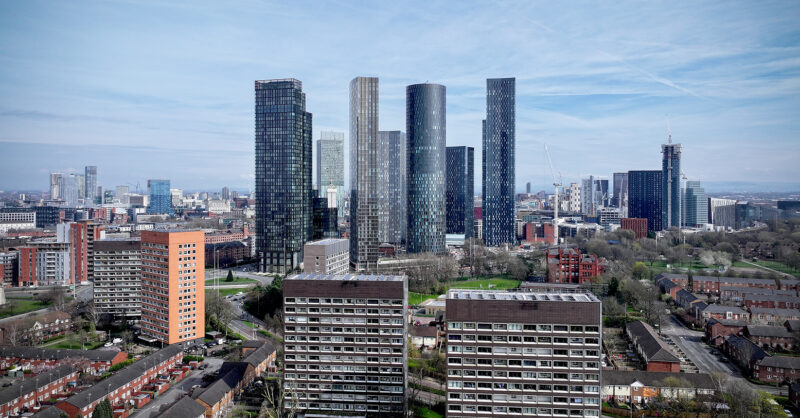
Andy Burnham's campaign launch video paints a picture of a transformed Manchester. “I knew in my heart politics in this country had to change,” he says, standing in St Peter's Square with yellow trams and gleaming skyscrapers behind him. “Working side-by-side with business we’ve built the country’s fastest growing economy. Manchesterism is the end of neoliberalism.”
The term, coined to frame Burnham's potential return to parliament, has been promoted as a radical repudiation of four decades of Thatcherite economics. In January he described it as “a modern and functional response to the high inequality, low-growth trap that came from the 1980s drive to privatise economic power and overcentralise political power in the Treasury”. His signature policy of bus re-regulation is held up as proof.
“Andy Burnham's 'Manchesterism' is criticised as neoliberal, not socialist, despite his claims it ends the Thatcher era.”
Yet critics argue that Manchesterism is not socialism at all, but a neoliberal model dressed in different clothes. The New Statesman points out that while bus re-regulation has brought cheaper fares and better coordination, the buses are not publicly owned — just regulated by a more empowered public authority. The actual Manchester model, it says, “has been to use the state to de-risk profitability for a particular kind of rentier capitalism”, leveraging planning powers, public land and subsidies to drive real estate-led regeneration. The result: rent rises and demolition programmes in the inner city that have driven displacement.
Burnham, meanwhile, is also crafting a carefully constructed personal image. An altar boy from the Northwest, his cultural Catholicism has become part of his political identity. If he becomes prime minister — which he may well do before the year is out — he would be only the second ever Catholic to hold the office, after Boris Johnson, who reverted to his childhood faith and married Carrie at Westminster Cathedral in 2021. Unlike Johnson, Burnham has never hidden his faith, and it adds to the broader narrative of a politician who presents himself as a break from the Westminster establishment.
But the tension between his rhetoric and his city's reality threatens to undermine that narrative. As Burnham champions “Manchesterism” from a podium in front of Renaker's glass towers, the question remains whether his programme really marks the end of neoliberalism — or just its reinvention.