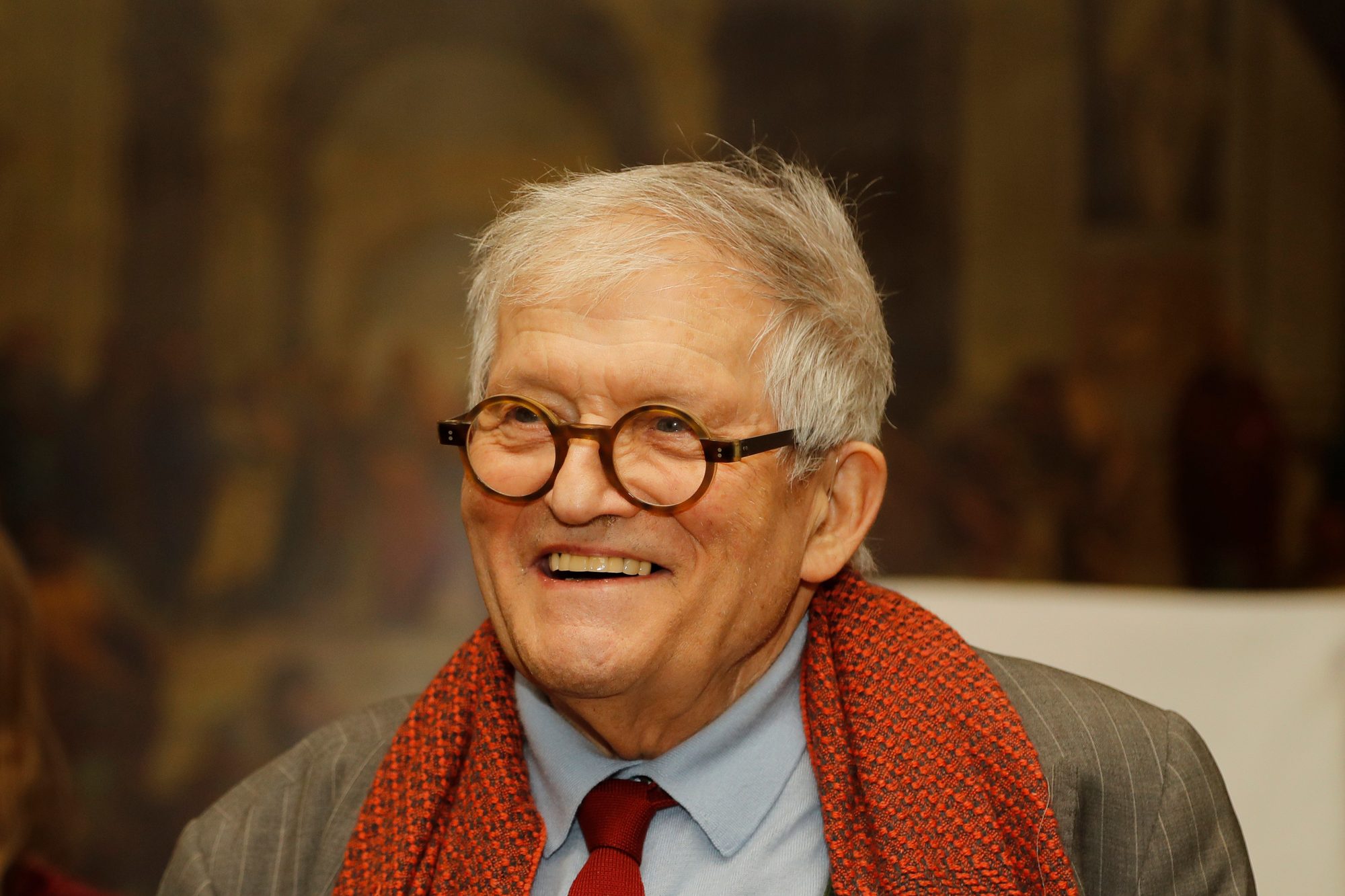
David Hockney, who died peacefully at home in June 2026 aged 88, once said “I prefer living in colour” – and he spent seven decades proving it. Born into a working-class family in Bradford, he became one of the most influential painters of the modern era, reshaping art with a relentless optimism that made him as beloved by the public as by critics.
Hockney was a painter, draughtsman, printmaker, stage designer and photographer, but above all he was a celebrant of the visible world. His subjects ranged from California swimming pools and Yorkshire landscapes to intimate portraits and still lifes. He embraced new technology throughout his career, from photocopiers and fax machines in the 1980s to the iPhone and iPad in the 2010s, producing luminous digital works that he insisted were no less art than oil on canvas.
“Explaining the life and legacy of David Hockney, the British artist who died in 2026.”
His approach was simple, but never simplistic. He believed that art required “the eye, the hand and the heart” – and that two were not enough. Drawing, he argued, brings us closer to the world around us. This philosophy made him a fierce defender of figuration and beauty at a time when much of the art world was dominated by abstraction and conceptualism. He was mildly contemptuous of what he saw as theoretical nonsense, but he was also a deep thinker about perception, constantly experimenting with perspective, colour and scale.
Hockney’s career took off in the 1960s, when he moved to Los Angeles and began painting the bright, sun-drenched pools and boys that defined Pop art. But his roots never left him: his love of the Yorkshire Wolds, where he returned to paint the changing seasons, produced some of his most celebrated works. In his later years, he settled in Normandy, where during the 2020 pandemic lockdown he created “A Year in Normandie” – an installation of 130 iPad paintings that traced the seasons on a continuous strip, inspired by the Bayeux Tapestry. That exhibition, shown at the Serpentine Gallery in London shortly before his death, was hailed as visually stunning even by some sceptics.
For UK readers, Hockney’s legacy is deeply personal. He was a national treasure who never stopped working, producing art that was accessible, joyful and defiantly pretty. His work changed the way we see: just as we cannot look at a French landscape without being influenced by Monet, so Hockney’s California pools and Yorkshire hills have become part of our visual vocabulary. He was also a gay man who came of age before decriminalisation, and his openness about his sexuality was quietly revolutionary. King Charles and Queen Camilla joined the art world in paying tribute to him, calling him a figure who reshaped modern art while remaining uniquely himself.
Q: What was David Hockney best known for? Hockney is best known for his vibrant, colourful paintings of swimming pools, California landscapes, and portraits of friends and family. He also pioneered the use of new technologies in art, from photocopiers to iPads, and his large-scale paintings of the Yorkshire Wolds became iconic.
Q: Why was David Hockney so popular with the public? His art celebrated joy and beauty in an often cynical art world. He made work that was immediately pleasurable to look at, full of bright colours and clear subjects, while still being technically brilliant. He also had a charismatic, approachable personality and a distinctive look with his round glasses and tweed suits.
Q: Did David Hockney use digital tools to make art? Yes. From the 1980s onward he experimented with fax machines, photocopiers and multiple cameras mounted on a Land Rover. In 2010 he began making paintings on the iPhone and iPad, producing thousands of digital works, many of which were exhibited in galleries as large-scale prints or installations.
Hockney leaves behind an extraordinary body of work, from exquisite pencil portraits to monumental landscapes. The Serpentine exhibition “A Year in Normandie” will continue its run, offering visitors a final chance to see the artist’s last major project – a defiantly beautiful celebration of nature’s cycles, executed with the same curiosity and zest he had shown since his Bradford childhood.