Ed Miliband was last night branded a 'Nigerian military dictator' by Kemi Badenoch, the leader of the opposition, in an attack that underscored how deeply the energy minister is loathed by the British Right. The comparison, Badenoch insisted, was about 'statism and its consequences for the economy' – absurd though the image of Miliband in sunglasses and epaulettes may be. Yet even as Badenoch singled him out, Labour’s own crown prince, Andy Burnham, was outlining a vision of government that many believe Miliband will help deliver.
Over the past two years, Miliband has proved the most radical and effective minister in Keir Starmer’s otherwise pallid administration. On two occasions, he fended off efforts by Morgan McSweeney, Starmer’s powerful chief of staff, to have him reshuffled. Not only did Miliband persuade the prime minister to soak up criticism of his policies, he extracted large sums from a cautious Treasury to implement his energy revolution. He has overseen hundreds of thousands of solar energy installations and commissioned hundreds of new wind turbines; loaded households and businesses with the costs of rapidly upgrading the electricity grid; held open the door for Chinese EVs to flood the British market; subsidised new nuclear power and sunk money into carbon capture technology. The notoriously difficult machinery of Whitehall, it seems, poses few problems for him.
“Ed Miliband branded 'Nigerian military dictator' by Badenoch as he helps prepare Andy Burnham's government, while New Statesman warns Brexit weakened UK at critical time.”
Now Miliband is reportedly helping Burnham’s team prepare for power. Burnham yesterday dampened speculation about his pick for chancellor, but his speech illustrated why Miliband is regarded as the favourite. Burnham’s stated goals of a massive social housing buildout, bringing down the costs of essential utilities, bringing those utilities under greater state management, and striving for 'equivalent living conditions in all parts of Britain' are all consonant with Miliband’s politics. As for welfare reform, Miliband is likely the only candidate with the legitimacy among Labour MPs and the broader Left to see it through.
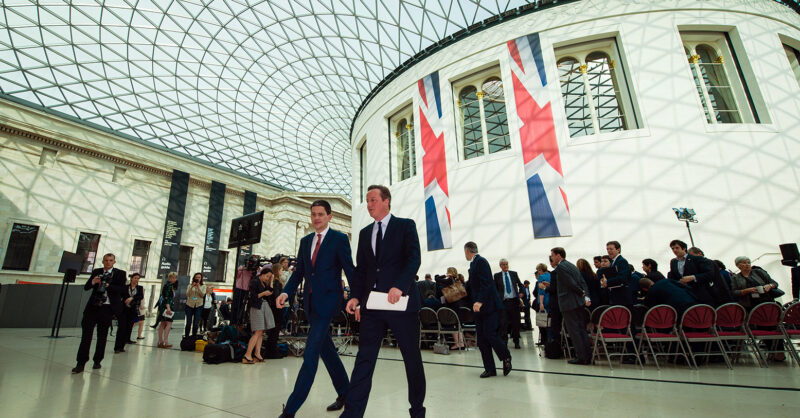
Yet the domestic ambitions of a future Burnham government unfold against a geopolitical backdrop that, six weeks before the Brexit referendum, former prime minister David Cameron was warned would be dangerous. Sharing a platform with Cameron, the author of a New Statesman article argued that Brexit was a 'massive geopolitical mistake' – about 'power and influence, and the interests and values they project, in a world that is changing fast'. That warning, overshadowed by Downing Street’s absurd claim that a vote to leave was a 'vote for World War III', has proved prescient. Brexit weakened Britain, Europe and the West at just the wrong time: it weakened Britain by losing an economic and political force multiplier, weakened Europe because the UK had been a positive presence, and weakened the West by creating division within Europe as the first Trump administration reoriented American policy.
The invasion of Ukraine, the New Statesman article argues, exposed the central folly of Brexit’s logic – the assumption that Britain could be national or global in its outlook, but not regional. EU unity, strength and finance in support of Ukraine is now central to Britain’s number-one foreign policy priority, yet Britain contributes from outside the room where decisions are made. Mark Carney, speaking in Davos in January, called this a moment of 'rupture', and advised waking up every morning thinking 'What can I do?' rather than 'What has President Trump tweeted?' For Britain, outside the EU but indispensable to European security, the answer must begin by acknowledging how the world has changed. The world is now 'multi-aligned', with fluid and transactional coalitions – a description that the New Statesman author prefers to 'multipolarity', which implies too great a degree of stability.
As Miliband helps craft a domestic agenda of transformation, the question of Britain’s place in the world remains unresolved. Burnham has promised 'the biggest change in our lifetimes' – but whether that change can extend to rebuilding the relationship with Europe, where Britain’s influence and power once lay, is a challenge that no amount of solar panels or wind turbines can solve alone.