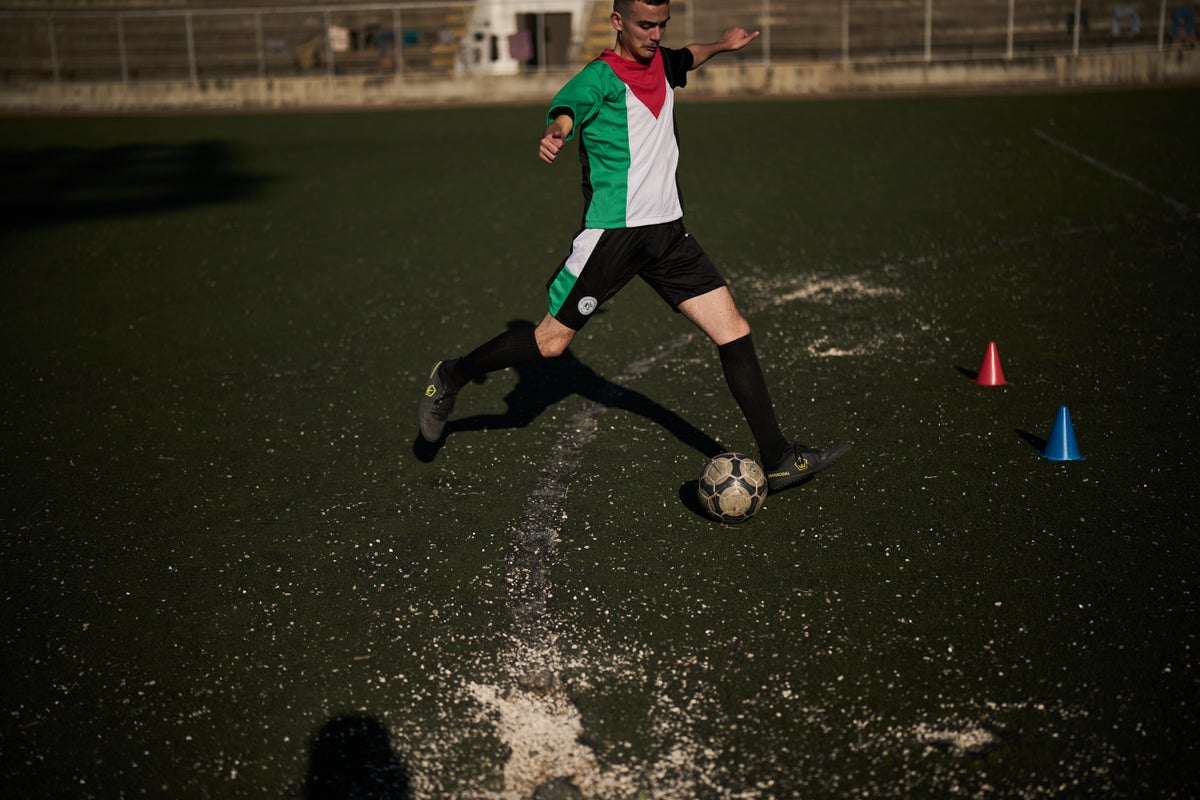
A youth wearing a Barcelona jersey bearing the name of Lamine Yamal kicks a ball across a worn municipal stadium pitch in Nablus, one of the few places in the occupied West Bank where a Palestinian boy can forget checkpoints, settlements and the Israeli army for 90 minutes. The ball sails past a rusting goal frame that has seen better decades. Behind the fence, a few miles away, lies the Carmel settlement.
As the FIFA World Cup gets underway on June 11 across the United States, Canada and Mexico – the first time 48 nations will compete – soccer remains both a passion and a struggle for many Palestinians. Among the Arab nations taking part in the tournament: Egypt, Iraq, Jordan, Qatar and Saudi Arabia.
“World Cup 2026 kicks off June 11 with 48 teams; West Bank Palestinians find brief escape in soccer despite occupation”
But on the ground in the West Bank, the game is an act of defiance against a daily reality of occupation. In the Bedouin village of Umm al-Khair, Palestinian boys watched helplessly earlier this month after their soccer ball, kicked beyond a barbed-wire fence surrounding a small pitch near the Carmel settlement, was taken away by a young Israeli settler.
“Wearing a Barcelona jersey bearing the name of Lamine Yamal, a Palestinian youth from a local soccer academy takes part in a training session at the municipal stadium in Nablus.” The image, captured by AP photographer Leo Correa, encapsulates the tension between passion and restriction.
This year’s World Cup will be like no other, with a record-breaking 48 nations competing to lift football’s biggest prize. England manager Thomas Tuchel is hoping to finally bring football home after a 60-year drought. Footballing legends Lionel Messi and Cristiano Ronaldo will likely make their final World Cup appearances.
But for the youth of Nablus and Umm al-Khair, the tournament offers a different kind of hope: an escape, however fleeting, from the walls, the soldiers and the barbed wire that define their lives. The ball may be taken away, but the dream remains.
Group A: Mexico, South Africa, South Korea, Czech Republic. Group B: Canada, Bosnia & Herzegovina, Qatar, Switzerland. Group C: Brazil, Morocco, Haiti, Scotland. Group D: USA, Paraguay, Australia, Turkey. Group E: Germany, Curacao, Ivory Coast, Ecuador. Group F: Netherlands, Japan, Sweden, Tunisia. Group G: Belgium, Egypt, Iran, New Zealand. Group H: Spain, Cape Verde, Saudi Arabia, Uruguay. Group J: Argentina, Algeria, Austria, Jordan. Group K: Portugal, DR Congo, Uzbekistan, Colombia. Group L: England, Croatia, Ghana, Panama.
Iran are currently set to compete despite the ongoing war. Uzbekistan, Jordan, Curacao and Cape Verde all make their World Cup debuts. The tournament ends with the final in New Jersey on July 19, after 104 matches.
And in the West Bank, every kick of the ball is a small victory.